

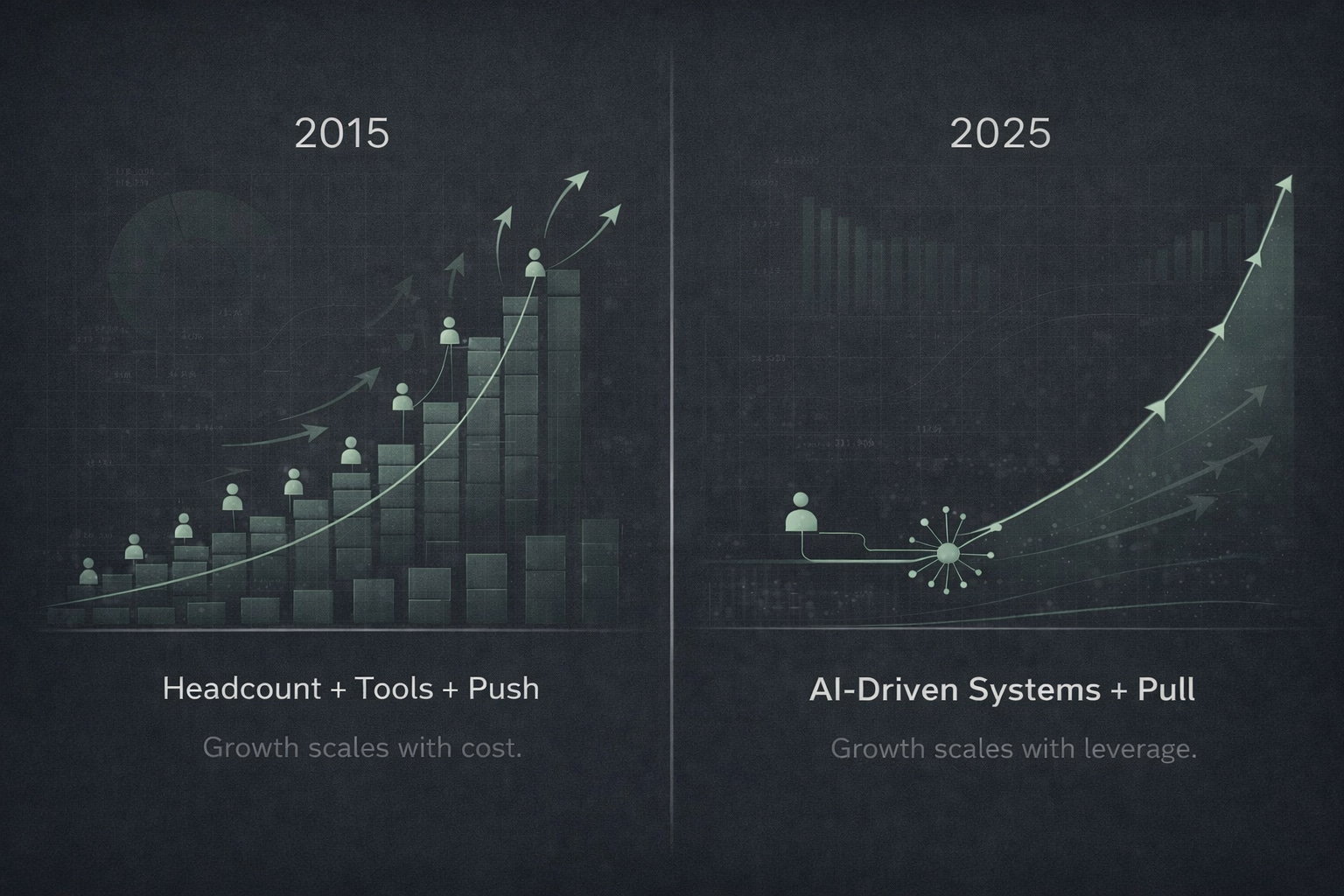
It’s become increasingly hard to justify the boiler-room SDR model.
The CAC payback on this approach has been weak for a while and hard to believe so many companies still operate as if it’s 2015.
As we head into 2026, agentic systems offer a path that costs little, generates more qualified leads, and converts more effectively with just one or two humans in the loop.
The Conversation
I recently chatted with a marketing ops wizard at a Series B deep tech company who has implemented a truly modern GTM motion.
It was clear she spent a lot of time thinking about how demand actually shows up, how it matures over time, and where human effort genuinely adds value. And despite the company having raised more than $35M, her directive was the opposite of what you might expect: build the leanest system possible for capturing demand so that more dollars could be allocated to the marketing efforts that actually move the needle.
Founder-led content. PR. Thought leadership. Education. Differentiated signal in the market.
Ten years ago, this same problem would have been “solved” with millions of dollars poured into an army of SDRs, layers of specialized marketers, and a sprawling collection of subscription SaaS tools.
Instead, she walked me through a workflow built on just two platforms: RB2B and Clay. Depending on website traffic and usage, the entire system costs roughly $5,000 to $10,000 per month.
No massive team behind it. No bloated SaaS stack costing $250K+ a year just to irritate prospects who aren’t in market. Just her, one SDR and a tightly designed system optimized around a single idea: capture as much real demand as possible, and make sure it’s handled correctly based on where the buyer actually is.
The SDR acts less like a hunter and more like an air traffic controller. His sole focus is high-quality conversations with leads to understand where those buyers actually are in their journey, not force a meeting. Then they would decide who warranted a pass to an AE vs. who belonged in longer-term nurturing through Hubspot.
The goal of nurturing wasn’t just to “stay in touch.” It was to ensure that when those buyers were ready, they were already indoctrinated in the company’s way of thinking and less likely to consider a competitor.
There was also no intention of hiring another SDR until it was absolutely necessary. Between being disciplined about tooling costs and explicitly optimizing for LTV:CAC, they’d embedded a culture of lean systems thinking from the start. The SDR was incentivized to incrementally improve the qualification process without sacrificing quality or follow-up SLAs.
They would need to be absolutely drowning before they’d consider adding headcount.
The result wasn’t just more leads. It was a system that captured demand without waste, without noise, and without adding people.
The System
Besides the cost advantages, the system is designed to capture meaningfully more value.
What matters isn’t just that it’s cheaper. It’s that it sees more demand, earlier, and handles it more intelligently.
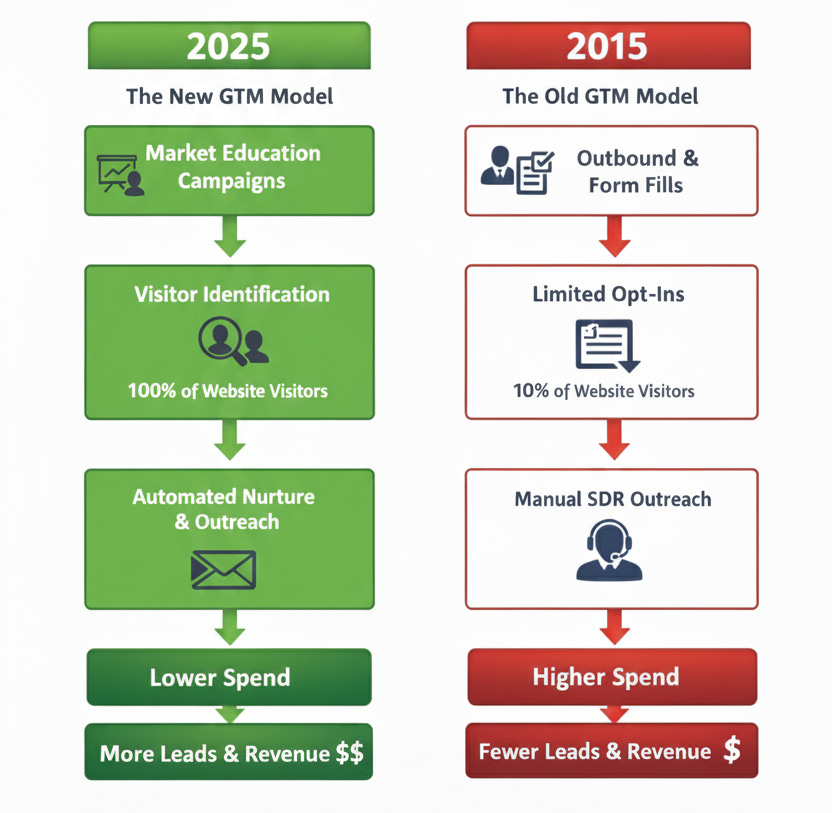
Step 1: Market Education Campaigns
At a surface level, this looks similar in relative cost and output to a best-in-class SaaS marketing motion from 2015. In fact, the 2025 version may be more expensive simply because there is more capital flowing into content creation and distribution.
The difference is what that spend is designed to do.
Instead of trying to manufacture demand or push buyers into a sales process, the objective is to educate the market by establishing a clear, differentiated point of view. Buyers self-select into your orbit because the content is genuinely useful, regardless of whether they are actively evaluating vendors.
The tactical details matter less than the principle: everything should ultimately lead back to owned channels. If the founder is active on LinkedIn, their profile should clearly route interested readers back to the website. The website is not just a destination, it’s the intake layer for the entire system.
System view:
Market education
→ Pull-based traffic
→ Buyers arrive earlier in their journey
→ Website becomes the demand intake point
This is the first economic shift: you’re no longer paying to force motion, you’re paying to surface latent demand.
Step 2: Capture the Lurkers
In 2015, only buyers who explicitly opted in ever entered the system. Download a whitepaper. Register for a webinar. Ask to speak with sales. These people understood what was coming next and, by definition, were already deep into consideration.
Everything else was invisible.
Some teams tried to solve this with chat tools like Drift, often spending $30K+ per year to engage buyers who were interested but unwilling to fill out a form. The justification was that contact forms created too much friction. In practice, this was often overstated. Realistically, only about 10% of website visitors were actually in-market at any given time.
With RB2B or similar de-anonymization tools, that constraint disappears. You can identify the vast majority of website visitors based on IP data, capturing the other 90% who previously slipped through the cracks.
System view:
Website traffic
→ Known accounts instead of anonymous visits
→ 100% of demand becomes visible instead of 10%
This is where the economics quietly change. You don’t need more traffic. You simply stop losing most of the demand you already paid to generate.
Step 3: The Follow-Up
Next was an automation layer that turned visibility into action.
All identified visitors were routed via Zapier into a Clay table, where each account was enriched automatically. From there, every contact received a soft, automated email from the SDR asking how they could be helpful.
On its face, this is invasive. That’s why the tone matters. These buyers did not explicitly opt in, and most are still early in their journey. Aggressive follow-up would destroy trust and compress the system in the wrong direction.
Instead, the default behavior is a slow, ongoing nurture. Buyers continue to get educated. Their understanding of the problem (and the company’s framing of it) compounds over time. When they finally reach consideration, they are already aligned and far less likely to evaluate competitors seriously.
As a sales guy, I was skeptical that defaulting to a slow-drip nurture (instead of persistent meeting requests) wouldn’t create a leaky funnel. But her response was simple: lead volume is more than sufficient.
While there is no pre-system baseline to compare against, the marketing ops lead shared that roughly 15–20% more website visitors were already in consideration but never opted in, despite multiple, static CTAs. When these buyers received the soft SDR outreach, many responded quickly, requesting demos or trials.
System view:
Lurker capture
→ Earlier timing
→ Softer outreach
→ Higher-quality conversations
→ Improved conversion
→ Better LTV:CAC
The SDR compensation model reinforces this behavior. Instead of optimizing for meetings booked, the SDR earns a higher base with bonuses tied to overall company revenue and qualified leads created. This removes incentives to force conversations and rewards correct routing: AE handoff when appropriate, nurture when it’s not.
They report directly into marketing and spend meaningful time improving the system itself, refining messaging at each stage and engineering incremental efficiency gains.
As buyers become increasingly resistant to overt sales motions, making push-heavy systems less economical, this GTM design highlights a broader shift. The gains don’t come from working harder or adding headcount. They come from seeing more demand, earlier, and applying human judgment only where it actually changes outcomes.
That distinction becomes even clearer when you compare this system to how the old models were built.
How the old model actually functioned
The legacy GTM system was built around a single assumption: humans were required to surface demand.
From the start, everything was organized around headcount. Large SDR teams segmented by territory. Some handling inbound. Others managing chat tools. Most focused on outbound, attempting to create demand through volume and repetition.
Marketing drove traffic, but the website itself was a blunt filter. If a buyer didn’t fill out a form, start a chat, or respond to outreach, they effectively didn’t exist.
In practice, only a small fraction of real demand ever entered the system.
System view:
Website traffic
→ Form fills and chats
→ ~10% of demand becomes visible
→ Humans chase signals manually
The remaining majority of buyers read content, evaluated options, and left quietly. There was no visibility, no follow-up, and no learning loop.
Instead of addressing that blind spot, the response was almost always the same:
→ More SDRs
→ More tools
→ More activity
This approach worked when capital was cheap and buyers needed help navigating immature categories. But it was an expensive way to compensate for a system that simply couldn’t see most of the demand it was paying to generate.
The economics finally make sense
Once you compare the two systems side by side, the difference becomes hard to ignore.
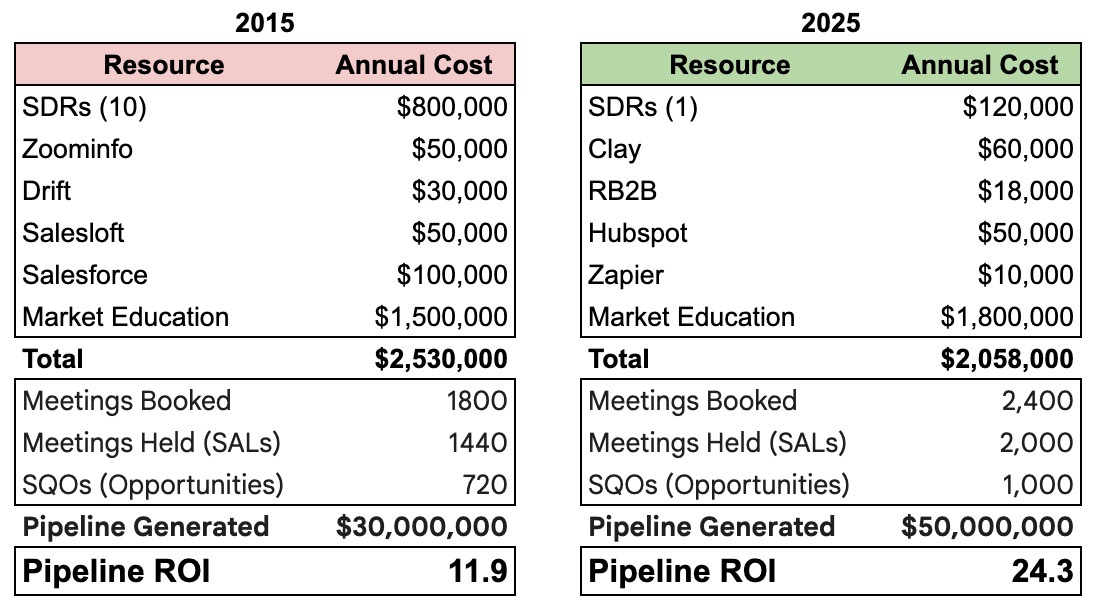
A 2015-style GTM model might look like this:
Twenty lower-skilled SDRs at roughly $80K all-in
Around $1M annually in headcount
Another $230K or more in tooling
All focused on actively working a small fraction of actual demand
In the newer model:
Market Education spend increases to get their ICP into their orbit, earlier
AI-driven capture and enrichment might cost ~$8K per month
One higher-skill SDR costs ~$120K annually
Systems touch the vast majority of incoming demand automatically
But the real advantage isn’t just lower cost.
When you move from seeing ten percent of demand to seeing most of it, opportunity volume increases over time. Conversion improves because timing improves. Long-term revenue grows because you enter the buyer’s journey earlier and stay present longer.
You don’t need aggressive assumptions for this to matter. Even small improvements compound when the top of the funnel stops leaking.
This is why the best teams aren’t optimizing for activity anymore. They’re optimizing for unit economics.
What best-in-class GTM teams are really doing now
AI isn’t replacing people. It’s replacing the assumption that people are required to move information through the system.
Once that assumption breaks, headcount-heavy SDR orgs start to look like an inefficient allocation of capital rather than a growth strategy.
The teams that get this right early aren’t just leaner. They’re calmer. Their reps are more effective. Their AEs spend time where it matters. Their buyers feel less pressured and more understood.
And they build all of this without continuously adding headcount.
Very insightful and sensible, I hope more teams move in this direction. The old way, in many ways, created an abundance of marginally useful content for lead capture. I have long preferred fewer, high impact pieces (with variants for testing) to volume. The qual/quant battle is real!