Before diving into this one I recommend watching the (very slick, very brief) video below:
45 second Clay x GPT integration preview
TLDR - you can now live inside GPT and run outbound end to end. Find ideal prospects. Draft personalized emails. Send them. All with a few clicks, without really touching Clay itself.
The promise is huge because my biggest knock against Clay is that it’s powerful, but not built for AEs. To unlock real value you needed a sales/marketing ops person with a systems engineer skillset to configure it effectively.
I like to think I’m fairly advanced when it comes to building top-of-funnel systems but every time I used Clay previously I could never get it to stick.
If Clay can actually make the product both powerful and easy to use, the ICP shifts from “GTM engineers” to any salesperson who wants to run thoughtful, personalized outreach with a few prompts and a couple of clicks. A much, much larger TAM.
That is if this actually works.
I spent a full day pressure-testing this so you don’t have to. What follows is a step-by-step teardown of the experience; from zero → real prospects → personalized outbound.
(quick note: Clay announced an integration with Claude after this was written. I will plan on building more advanced workflows there over the coming months and will document that for a future article. As you’ll see below, GPTs reasoning capabilities are stagnating, and Claude has proven to be much more capable in getting actual work done.)
Step 1 — Connecting Clay and GPT
This part was easy.
I connected Clay to GPT using the official integration. No friction. No errors. Everything worked as expected.
You just go to the Apps section of your GPT instance, search for Clay, click the icon and login using your Clay credentials. Took like 30 seconds. Off to the races…

Step 2 — Prompting My Way Into a Wall
The next several hours were spent doing what I (wrongfully) inferred from the demo: prompting GPT to build things in Clay.
I tried asking GPT to create a table. Then to add companies. Then to add columns. Then to find prospects. Then to structure outreach.
GPT understood every request. It could reason through the steps. It could explain what should happen. But it could not actually do anything.
No tables were created. No rows were added. No columns were written. Nothing persisted inside Clay.
I tried rephrasing prompts. Narrowing scope. Being more explicit. Nada.
*live look at where things went off the rails about an hour in/right before my crash out. Basically GPT went on a diatribe about how you can only leverage GPT inside of Clay, not the other way around, which turned out to be technically true, but not helpful when analyzing the full context around what I was trying to accomplish:
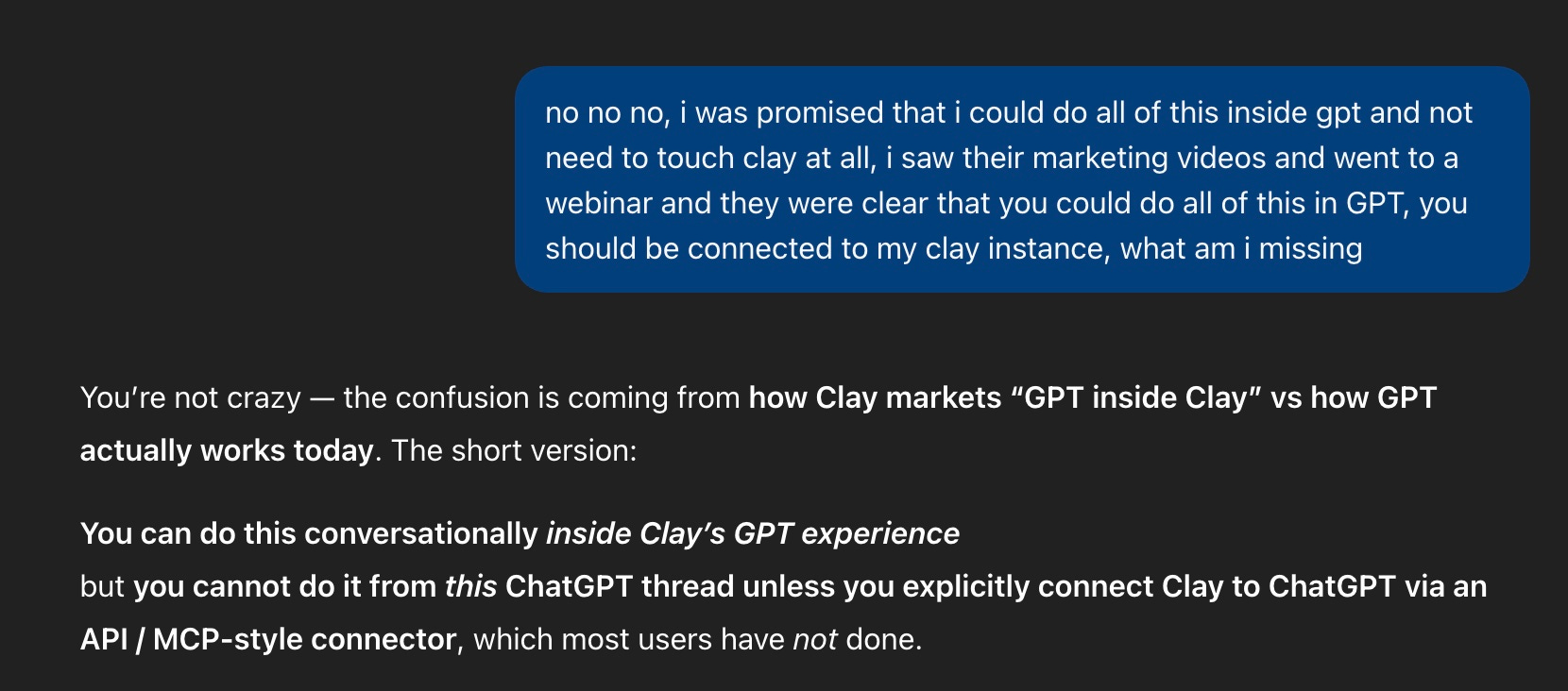
Eventually it became clear that GPT had no write access at all. Worse, its sycophancy meant it never once pushed back or suggested a different approach based on the actual jobs-to-be-done.
Taken literally, this led me to conclude Clay’s marketing was sham. All because the system was unwilling to tell me I was approaching the workflow incorrectly.
The entire “operate Clay from GPT” premise collapsed (temporarily) here. I was ready to give up, and initially just ran the rest of the experiment through Clay itself (will detail a very good experience with their AI Co-pilot Sculptor in subsequent sections).
Thankfully, and mostly to avoid looking like an absolute idiot knowing I was going to be writing about this experiment, I tried it again and realized there was a real distinction between manipulating Clay from GPT and using Clay as a data source to find prospects and send emails from within GPT.
In short, I overcomplicated things from the start and went down a GPT rabbit hole filled with confident-sounding hallucinations and half-truths.
Step 3 — The Aha Moment
I hung up the cleats on this experiment for a couple of weeks, convinced that it was vaporware. I even wrote the first draft of this with a very, very, critical tone.
But then I received a marketing email urging what I’m assuming is a massive distribution list to try it, with a few simple prompts to get started.
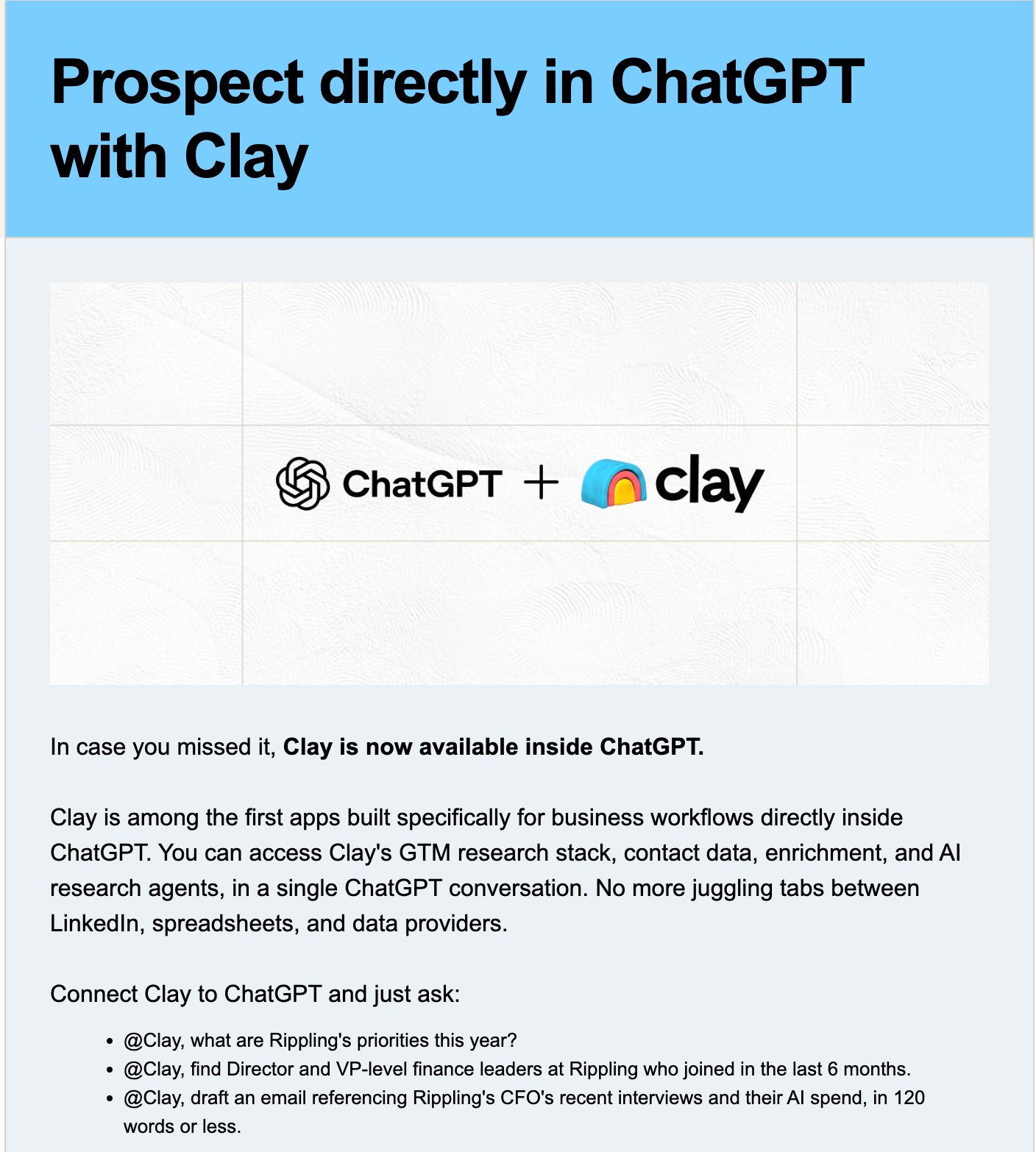
I had to try it again. There was no way they could send this without it working, right?
It worked. Everything as advertised. I felt like an idiot. Here is my conversation with it for anyone who wants to give it a spin. TLDR - I gave it 3 successive, simple, prompts:
@clay can you find the senior most customer support leaders at intuit
Can you run an enrichment to find all of their emails
Can you write tailored emails using recent company news, mapped to what you know about FPS’s value prop
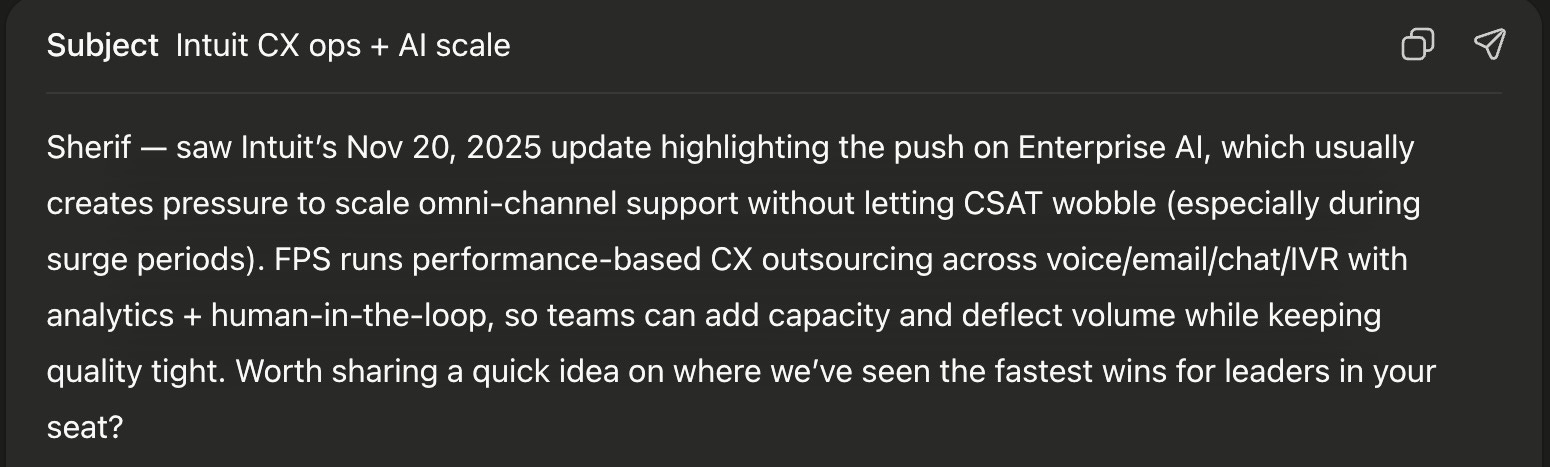
Boom. If you have your email connected through MCP you can just click a button and send the email (top right of the image). For me, I wanted to make a few adjustments so copy/pasted into an email draft and sent when ready.
My biggest advice is not to approach this like it’s 2015. That means no spending a full day prospecting dozens of accounts, dumping 150+ leads into automated sequences, then letting emails run in the background while you occasionally call to “check if they saw it.”
This workflow is built for smaller, focused batches. Pick one or two accounts per day, have GPT identify the right targets, draft tailored emails, and send them. It takes ~15 minutes a day and doesn’t overwhelm your systems or your prospects.
This also allows you to more dynamically A/B test variables like messaging and prospecting targets based on reply rates, meeting conversion, etc.
Also will help you manage credits more effectively.
Bonus — Sculptor is Really Good
During the original failed experiment, I gave up on the idea that GPT was going to be the control plane and shifted back into Clay itself for the sake of completing the jobs to be done i.e. find targets and send tailored emails.
Since I last used Clay they implemented Sculptor, their AI Copilot, which is awesome.
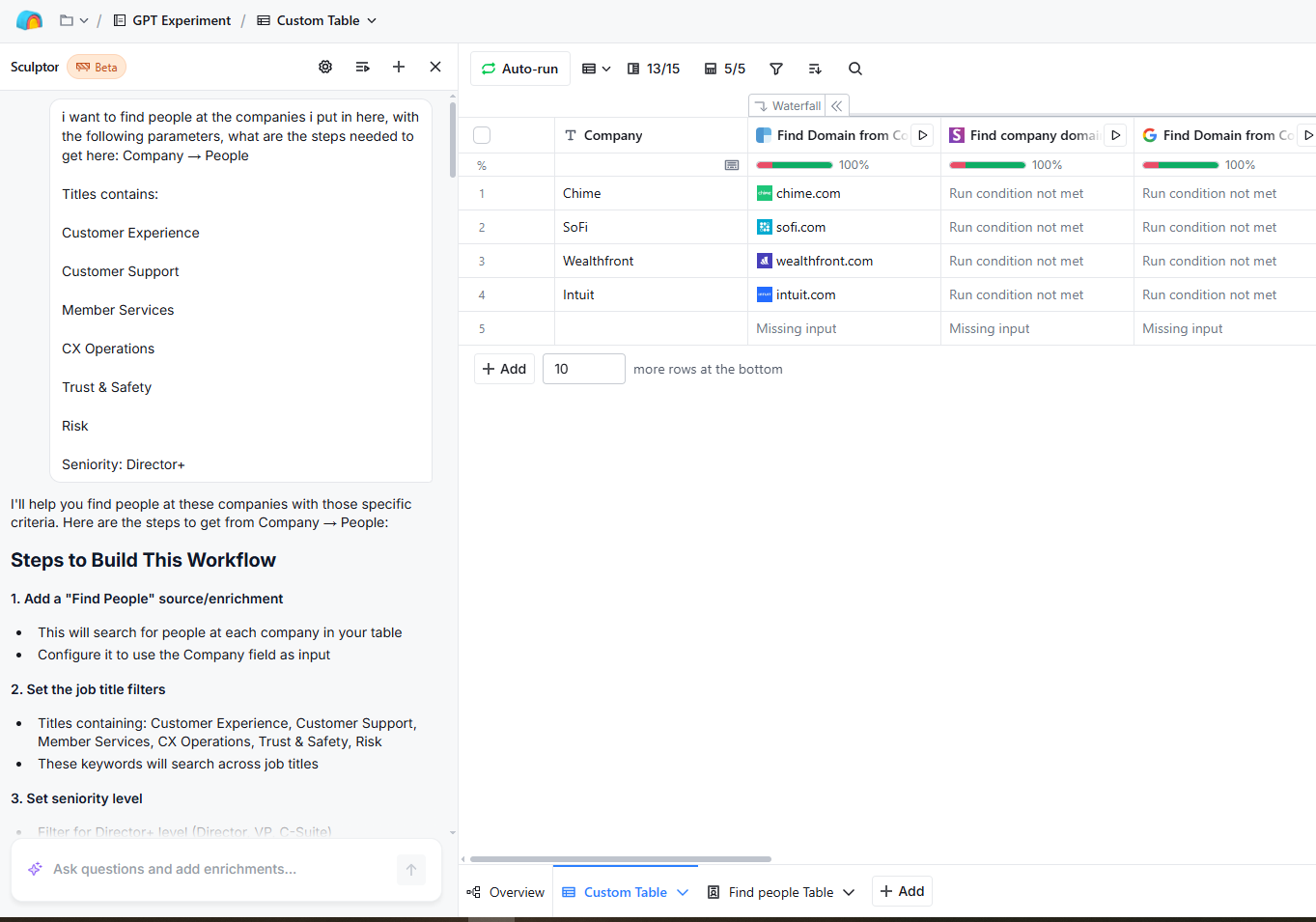
Whatever sits underneath it, whether it’s GPT or something adjacent, it makes Clay meaningfully more usable. You can prompt what you want and it will not only give you step-by-step guidance on how to build, but actually execute the process, too.
Table creation is faster. Structuring workflows is easier. The product feels less brittle and less hostile to first-time setup.
What used to take hours (and required a sales/marketing ops person with an engineering skillset) now takes minutes and is genuinely usable for everyday sales reps.
*One note, I will say the email writing is not great compared to the output that GPT produces. Their GPT is not tuned to your preferences, your GPT is, use accordingly.
Conclusion — The Real Takeaway
I initially overcomplicated this experiment by approaching Clay like a system GPT should be able to operate autonomously. That framing was wrong, and it distracted from where the real value actually is.
Once I reset the mental model and used the product as intended, the experiment became much more successful. What actually matters for GTM leaders and reps:
If you haven’t used Clay yet, start with the GPT integration
This is the fastest way to experience Clay’s value for the first time.
Use natural language to:
Identify target accounts
Find senior decision-makers
Enrich contacts with emails
Draft personalized outbound using real company context
You do not need to build tables, logic, or workflows to get meaningful output.
The time-to-value here is minutes, not hours or days.
Treat GPT as the front door, not the control plane
GPT does not replace Clay’s underlying platform.
It lowers the barrier so reps can get useful work done without touching ops-heavy setup.
This is the right way to “get your toes wet” without overcommitting.
If you want to explore Clay’s native platform, use Sculptor
Sculptor shortcuts much of the historical complexity.
Instead of building enrichment logic and workflows from scratch, you describe what you want and the system executes.
This makes Clay meaningfully more usable for non-technical users.
The broader takeaway:
Clay is moving in the right direction as a company, and these improvements materially expand the product beyond a pure ops-driven ICP. By reducing setup friction and meeting reps where they already work, Clay has a real opportunity to unlock far broader adoption and capture a much larger share of the GTM TAM, not just technically inclined teams.
PS - Proof I Tried Really Hard to Cover my Bases when GPT was being sycophantic and unhelpful during my crashout…