

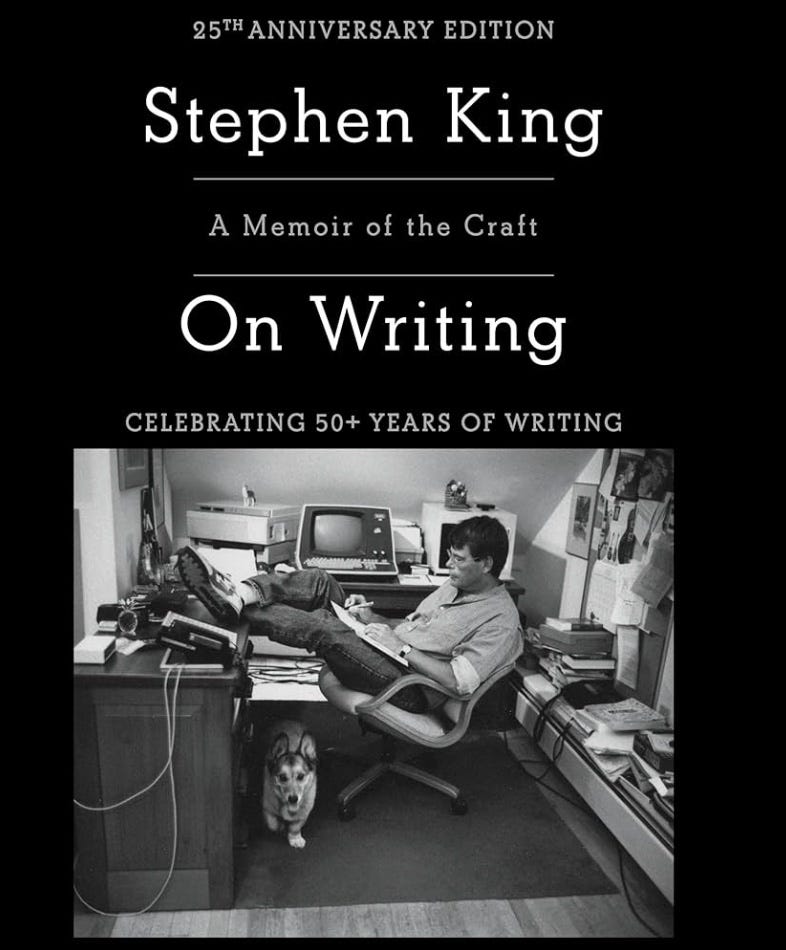
Stephen King’s autobiography On Writing came out in 1999.
I read it a long time ago, and don’t remember much except liking James Patterson’s book better.
If I had to guess, the main takeaway is that writing is the process of translating thoughts onto the page with the intent to communicate them clearly.
*Emphasis on your own thoughts, with a clear demonstration of uniqueness of thought, achieved through many iterations of analysis, editing and wordsmithing.
The introduction of AI into any writing process makes things confusing.
Emdashes, “it’s not x, but Y” sentence structures, and the words “genuinely” and “quietly” are technically indicators of great writing. Which is why AI models default to them when producing copy.
But these stylistic choices are now oversaturated. They’re a telltale sign that “AI-wrote-this” which dilutes their value in communicating ideas. They no longer represent uniqueness of thought. So how should communicators (including GTMers) write in the AI era?
Not using AI to help you write is stupid, but so is outsourcing the writing process completely. The key is identifying when original thought is valuable.
Where to use AI from Soup-to-Nuts
A lot of important writing in GTM doesn’t require a distinct voice. It requires speed, clarity, and consistency to communicate value. Standard best practices work here because that’s how buyers process information and make decisions.
The more standardized the format, the better AI performs. Once the reader knows what to expect, AI can match that expectation quickly and cleanly.
Case studies — the goal is to clearly show how a client like them had a problem, how your widget solved it, and the business impact that resulted; AI works because the structure is fixed and the reader is scanning for proof, not originality
Blog posts (especially SEO-driven) — the goal is to organize information in a way that’s easy to digest and rank; AI works because clarity and coverage matter more than voice
Emails — the goal is speed and clarity of communication; AI helps because most emails are functional, not expressive
Proposals — the goal is to communicate scope, pricing, and expected outcomes without friction; AI is strong here because readers want completeness and structure, not nuance
Summaries and internal docs — the goal is to reduce time spent processing information; AI is useful because it compresses content into something immediately usable
In all of these, the reader/buyer isn’t evaluating distinctive style or authenticity. They’re trying to understand something quickly and make a decision. Efficiency is the point.
It removes the blank page, speeds up the first draft, and gets you to something usable without a lot of effort.
Where it falls short
The easiest way to understand the difference is a client presentation, but this can be extrapolated to anything where buyers need to understand things super deeply to make the right decision.
If the examples of above are more top-of-funnel, think of this as middle-to-bottom of funnel.
Client Presentation: Version 1 — AI as an execution machine
You ask AI to build the deck, summarize the source material, create the slide flow, write the talking points, and polish the language.
It will definitely make you faster and get you something structured, clean, and directionally useful.
But if you don’t understand the material at a deep level, you won’t be able to explain the logic, adjust to the client’s priorities, or answer questions when the discussion moves somewhere unexpected. You’ll have a polished artifact, but you won’t actually be prepared to sell, advise, or lead the conversation.
That is a bad use of AI. You’re just outsourcing the work when the actual value is in the ability to communicate the thoughts, ideas and strategies behind the writing.
Client Presentation: Version 2 — AI as a strategic thinking partner
You use AI to help organize the material, pressure test the narrative, identify gaps in your logic, and think through how the client is likely to interpret the story.
Then you use it to help produce the deck faster.
This may not save a dramatic amount of time versus building the deck manually. You still have to do the work. You still have to understand the material, scrutinize the logic, decide what matters and what doesn’t so that you can effectively communicate your value.
But even if the deck copy is the same between versions, the quality of the output is much higher.
AI helped you structure the thinking, and then executed against the writing. Which is kind of what great writing is in the first place…
TLDR
Most of the writing that actually drives outcomes in GTM sits in that second category. You’re not just passing along information, you’re shaping how someone interprets it, how they think about a problem, and whether they trust you enough to act.
It handles the structured, repeatable parts of the work extremely well and removes a lot of the drudgery around getting started. But it doesn’t replace the thinking, and it doesn’t replace the communication layer that actually creates differentiation.