


You probably don’t know the guy above. His name is Peter de Jager.
He worked at IBM in the 70s and 80s, and in the late 90s became notorious for inventing and perpetuating Y2K on all major media outlets (CNN, PBS, ABC News, etc.).
For the uninitiated, Y2K was the belief that digital systems would fail because they weren’t programmed beyond 1999. If these systems stopped working everything tied to them (banks, electric grids, airlines, trains, etc.) would also fail.
As the millennium approached, he proselytized this doomsday scenario and stirred people into a frenzy. Guns, non-perishable food, and doomsday bunker sales took off.
Though there is no evidence he had any stake in those industries, he did own www.year2000.com, generated significant revenue through advertising, and eventually sold it.
Once the millennium hit and the systems were fine, we never heard from de Jager again. I wouldn’t say his motives were purely for profit. But when someone benefits from public panic, it is worth asking about their incentives, especially when the audience is already anxious about technology’s impact on the labor market.
AI is the same panic with a new name. The media will insist otherwise because “this time is different” gets attention, and attention sells ads.
Here are a few technologies that were supposed to destroy society but ended up making it far more valuable.
The Automobile
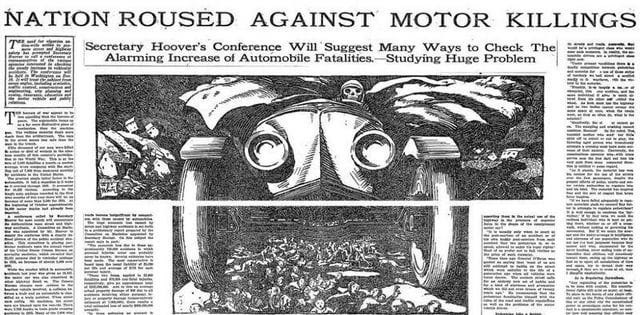
This is a NYTimes article from 1924. Among other things, it claimed cars are more dangerous than machine guns…
Early cars were called “devil wagons.” A 1900 newspaper described the automobile as a machine whose mission was to “destroy the world.”
In 1908, The Bullitt County News reported on a Kentucky bill designed to “Put ‘Devil Wagons’ Out of Business.” The bill’s sponsor promised to describe the “dreadful horrors of the automobile” and the damage it inflicted on the nerves of both mules and their drivers.
There were real safety concerns, but the fear also had economic beneficiaries. Carriage makers, stable owners, blacksmiths, breeders, feed suppliers, and countless workers depended on the horse economy. A technology threatening to wipe out that entire network did not just create public anxiety. It created a constituency with every reason to magnify that anxiety through newspapers, local politics, and legislation designed to slow the car down before it could reshape the market.
Much of the horse economy disappeared anyway.
Then came automobile manufacturing, dealerships, mechanics, gas stations, insurance, highway construction, interstate trucking, motels, drive-through restaurants, suburbs, warehouses, and modern logistics. Cars reshaped where people lived, how businesses distributed goods, and where entire cities were built.
Automation (in the 1960s)
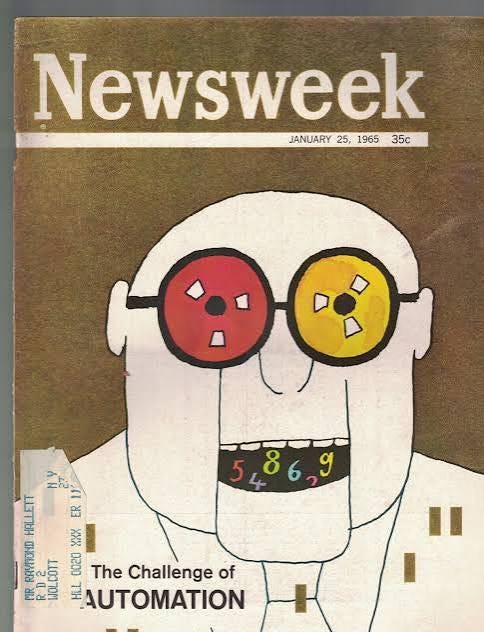
Before getting to AI, it is worth remembering that we already had an automation panic.
In January 1965, Newsweek ran a cover story called “The Challenge of Automation.”
The article claimed automation was wiping out 35,000 jobs every week, or 1.8 million jobs a year. In New York City alone, automatic elevators had eliminated 5,000 elevator operator jobs since 1960. Computers and automated systems were no longer being framed as tools for making factories more productive. They were being framed as a direct threat to the worker’s place in the economy.
Businessmen loved it. Workers feared it.
Unions, displaced workers, politicians, and industries built around older labor models had every reason to treat automation as something that needed to be slowed, negotiated, regulated, or made less threatening.
The machines spread anyway. Mainframes, automated elevators, industrial controls, business software, databases, and eventually personal computers became ordinary parts of economic life. The same systems accused of labor displacement became the infrastructure for finance, logistics, payroll, accounting, inventory management, telecommunications, and modern office work.
Today, nobody sees an elevator without an operator and thinks society made a catastrophic wrong turn. Nobody sees a computer inside a business and treats it as a novel threat to the labor market. It just became the backbone for how things got done.
AI

Every one of these revolutions had the same pattern. People overestimated what the technology would destroy and underestimated what it would make possible.
In 2023, hundreds of researchers and tech executives compared AI extinction risk to nuclear war and pandemics. In 2025, Axios warned of a coming “white-collar bloodbath.” Dario Amodei predicted AI could eliminate half of all entry-level white-collar jobs and push unemployment as high as 20 percent. Geoffrey Hinton has warned of “massive unemployment” and a future where a small group gets much richer while most people get poorer.
Some of that fear is reasonable. Cars destroyed the horse economy. Electricity destroyed gas lighting. The internet destroyed newspapers’ control over information and distribution. AI will shrink or eliminate roles, especially entry-level roles built around work that is suddenly cheaper to automate.
But this is not the whole story. The harder question is what happens after capable intelligence becomes cheap, abundant, and embedded inside every workflow. Large language models are already moving toward commoditization. Eventually, the model becomes the least interesting part of the system. Advantage shifts to proprietary knowledge, customer relationships, distribution, judgment, and the workflows companies rebuild around that intelligence.
Within the next year, people will stop announcing that they are using AI. They will review contracts, analyze customers, write software, build campaigns, and make decisions through systems that already contain it.
AI will simply become how work gets done and the labor market will shape itself around. It will be a major technological disruption but it will almost certainly not be the most significant one we have ever seen.