

Anthropic’s IPO will be massive.
Not sure what the market reception will look like. It’s not in my bag to speculate. But I can confirm that it has fundamentally changed how I work.
More productive, yes, but it’s also creating a shift in how things gets done broadly. For example:
I haven’t logged into Clay in months, but use it daily. I start with Claude to strategize outreach campaigns to align on targeting (who) and messaging (why now). Claude then goes into Clay (via MCP) to build a prospect list AND draft the message sequence. Once I approve, everything automatically moves to Lemlist for execution.
For thornier emails, I’m not drafting in Gmail. I have Claude analyze the relevant communications in my inbox and CRM to ensure the note lands with the right tone, length, CTA, etc. depending on the specific nuances of the opportunity.
The design capabilities are also getting really good. I’m slowly moving away from needing google slides/docs to generate client materials (not all the way there yet, but close).
Outside of needing to send contracts through Docusign, there aren’t many other places I work out of. I run pretty lean, so collapsing all of my work into Claude has been relatively easy.
This transition makes OpenAI’s supposed “iPhone killer” feel less stupid. If work keeps collapsing into one AI interface, increasingly through voice, a device built around this workflow feels more real than it did even 3 months ago.
Still, I realize larger organizations can’t transform as quickly, and plenty of existing software will continue to play a prominent role in where and how work gets done.
Stage 1: AI gets layered underneath existing work
Most companies have years of process built around Salesforce, Microsoft, Google, ERPs, finance tools, etc. They have more operational debt invested in those systems, plus security requirements, training, governance and thousands of employees who already know how to work inside them.
The first phase will keep employees using the same applications, while AI starts doing more of the work underneath.
A quote gets partially prepared before anyone opens the request. Customer history gets assembled automatically before a sales call. An invoice gets checked before accounting reviews it. A support request gets categorized and routed before an employee touches it.
Getting there will require a lot of help.
Someone has to understand how the business actually operates, figure out which steps are worth automating, connect systems that don’t naturally work together and decide where human judgment is still needed.
This is a massive opportunity for firms likes Accenture and Deloitte. The frontier labs will make their products easier to integrate over time, but they won’t invest in a Prof Serv team to deploy their solutions according to each company’s specs.
Stage 2: AI becomes the place where work gets done
Eventually, though, everyone will realize jumping from tool to tool is a pain. All work will collapse into a single point of execution.
Clay still matters, but I never use the application itself. Claude calls Clay when I need data. It calls my CRM when it needs account context. It interacts with my email when I need to understand a conversation. Increasingly, the individual applications become infrastructure underneath the place where work happens.
For most of the SaaS era, companies competed to own the UX where a specific job got done. Salesforce wanted sellers inside Salesforce. Workday wanted HR leaders in Workday. IT people in ServiceNow, etc.
And with AI as the command center for everything, how will software remain valuable?
Clay understood this early. They recognized the value was in the proprietary data and infrastructure underneath the product, not keeping users inside the app. They were one of the first to release an MCP, making Clay easy for sellers to use directly from their LLM of choice.
More software companies will have a harder time because they are glorified distribution centers. Packaging readily-available information catering to a specific audience. Too much value is placed on specific users being in the platform vs. proprietary data they’ve built a moat around.
The current version of this is still pretty primitive. I sit inside a chatbot and tell Claude what I want done. I doubt the chatbot is the final interface.
Stage 3: The computer starts to disappear
My big prediction for 2027: people will spend more time talking than typing prompts into LLMs. Once you try it, it’s hard to go back.
And if the system can understand the outcome I want, without the self-editing that naturally occurs when your brain tells your fingers what to do before it reaches the computer, then the importance of the keyboard, mouse, browser and even individual applications starts to decline.
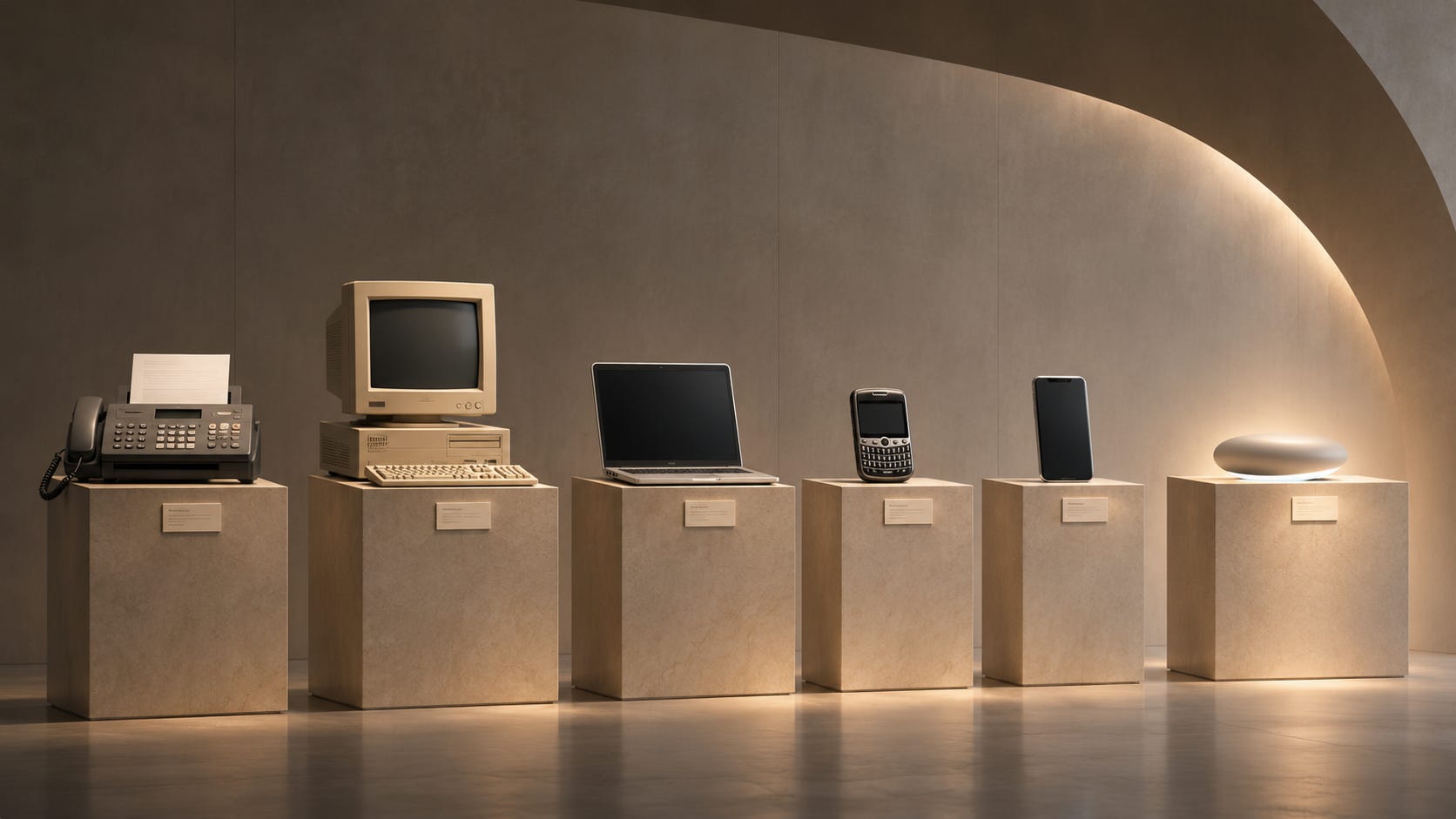
At some point, laptops and phones begin to look like infrastructure from a previous era.
Think about it, the fax machine was once an essential business device because the surrounding system required it. GPS units, answering machines, MP3 players and countless other devices felt indispensable until their functions were absorbed into something better.
The real breakthrough would be removing as much friction as possible between having an idea and getting it done.
Today that still means opening Claude, talking into a microphone, reviewing what it produces and occasionally jumping into another application. That is already much faster than how I worked last year.
Now imagine removing most of the remaining steps.
What the winning device ultimately looks like, no one knows. But I am certain that once intelligence reaches the top of the market maturity curve, the next curve to develop will be the hardware that makes intelligence 10x more efficient.